AI will replace coders, not engineers
The discourse keeps asking the wrong question. 'Will AI replace programmers?' is a coin flip dressed up as analysis. The honest question is which kind of programmer, and the answer is uncomfortable for one half of the industry, liberating for the other.
I’ve been having the same conversation, in different rooms, for two years now. A junior engineer asks if they should still bother learning to code. A senior engineer asks if their job is safe. A CTO asks if their team is twice as productive yet. A bootcamp grad asks if it’s too late to start.
They all want the same thing: a yes-or-no answer. They are all asking the wrong question.
“Will AI replace programmers?” is a coin flip dressed up as analysis. It pretends “programmer” is one job. It isn’t. It hasn’t been for a long time. The honest version of the question is: which kind of programmer, and what are they actually doing all day?
Once you ask it that way, the answer stops being scary and becomes unusually clear. AI is going to absorb a huge chunk of one kind of work and make the other kind more valuable than it has ever been. That’s not a hedge. That’s the structure of what’s happening.
Two words people keep treating as synonyms
The whole confusion comes from collapsing two activities into one word.
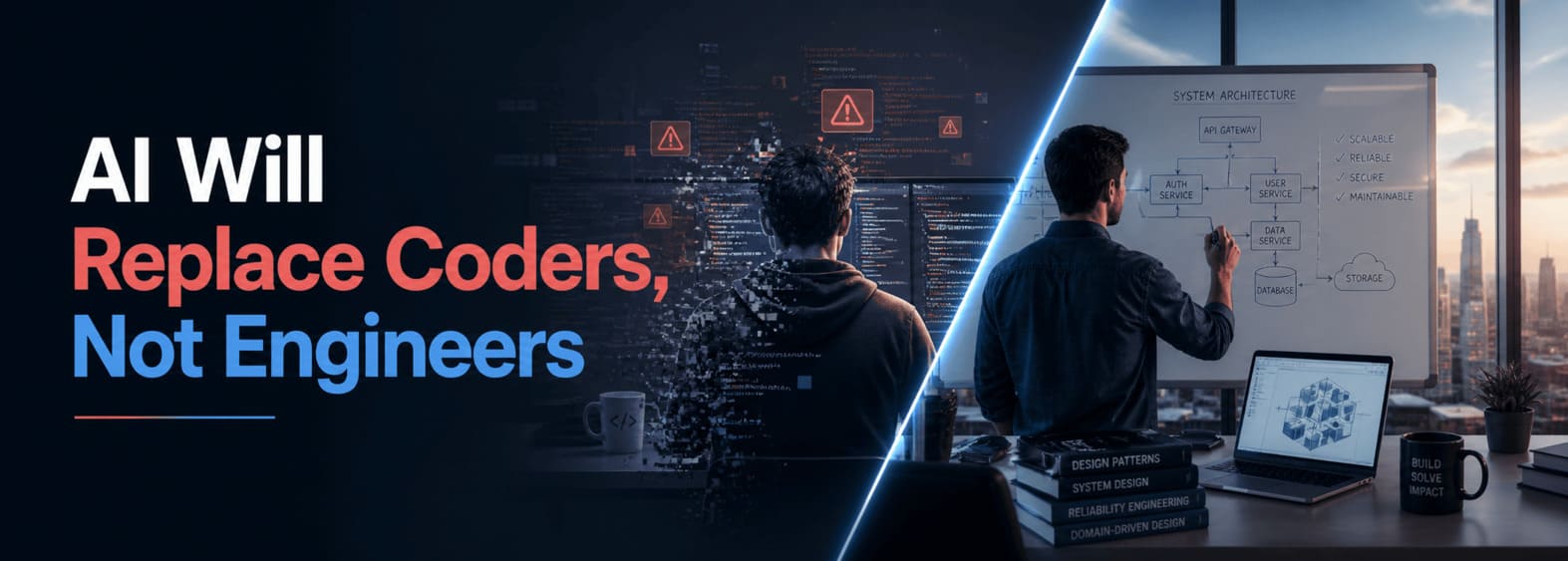
Coding is producing code that satisfies a specification. Engineering is deciding what the specification should be.
A coder receives a ticket (“add a filter for archived projects to the dashboard”) and writes the function, the test, the styles. An engineer receives a problem (“users can’t find old projects, support is drowning”) and decides whether the answer is a filter, a search box, a different default sort, an archive page, or a redesign of how projects are surfaced in the first place.
Both kinds of people exist on every team. They look the same on LinkedIn. They sit at the same desks. They open the same IDE. At small scale, the same human is often doing both: half the day coding, half the day engineering. At large scale, the activities decouple, and the coder-heavy half of the org chart starts feeling different from the engineer-heavy half.
This distinction was always there. AI is what made it suddenly load-bearing.
What AI is genuinely good at
I’m going to be precise here, because hand-waving in either direction is the source of most of the bad takes on this topic.
A coding agent in 2026 can reliably:
- Translate a clear, well-bounded specification into working code.
- Refactor mechanically: rename, extract, codemod across many files.
- Write the boring half of a test suite once you’ve sketched the first test.
- Read an unfamiliar codebase and summarize how a piece works.
- Generate a syntactically plausible answer for any framework, library, or syntax you can name.
That last one is the dangerous one, but we’ll come back to it. Notice what every item on this list has in common: the human has already done the hard part, the deciding. Given a clear ticket, the agent ships. Given a clear refactor target, the agent refactors. Given a clear test scaffold, the agent fills it in.
What this means in practice: the parts of the job that translate intent into code are now mostly mechanical. They were always 60–80% of a working day for the average software engineer. They are still 60–80% of a working day, except the engineer isn’t doing them by hand anymore.
What AI is genuinely bad at
This is the list every honest senior keeps in their head when they use these tools:
- Deciding what to build. The agent has no skin in the game. It has no roadmap, no users, no stakeholder politics, no quarterly objective. It will gladly implement the wrong feature, perfectly.
- Architectural trade-offs. Should this be a separate service? Should we cache? Should we redesign the data model or duct-tape the migration? The agent has opinions; the opinions are statistically averaged from the internet.
- Naming. A bad name compounds for years. The agent’s naming is plausible. Plausible is not the same as right.
- Judging when “works on my machine” is enough. Real engineering decisions are mostly about when to stop. The agent has no instinct for that; it stops when its loop terminates.
- Knowing what it doesn’t know. Hallucinated APIs, deprecated patterns, libraries that don’t exist, security mistakes that look like best practices. The agent will write them with the same confidence it writes correct code.
You’ll notice these are not “things AI will get better at next year”. These are categorical. They aren’t capabilities the model is one training run away from acquiring. They are properties of the situation: the model isn’t accountable for the outcome, and accountability is the job.
Why “just coding” is the dangerous spot
Pull those two lists together and the picture sharpens.
If your day-to-day is:
- Picking up tickets someone else wrote
- Translating them into code
- Submitting a PR
- Moving on
…then the agent does your job already, in most languages, at roughly the level of a competent mid-level engineer. The reason your team hasn’t replaced you yet is mostly that the rest of the org doesn’t trust the output without supervision. That trust gap is closing fast, and it isn’t closing in your favor.
This isn’t a moral judgment of anyone. There are good reasons people end up in this position: bootcamp pipelines optimized for it, companies that hired for it, a decade of “just learn to code” career advice that pointed straight at it. Those reasons don’t change the structural fact: the part of programming that’s purely “translate ticket to code” is the most automatable cognitive work in the modern economy, and the work is being automated.
If you read that and feel defensive, sit with it for a minute. The point of this article isn’t to write off anyone. It’s to be honest about what the next five years look like so you can choose what to do about it.
Why the engineering half gets more valuable, not less
Here is the part that the doom takes consistently miss.
The bottleneck on every project I’ve ever shipped wasn’t typing speed. It was deciding correctly. The shortage in software has always been judgment, not output. AI cranks the output dial to eleven. The judgment dial doesn’t move automatically; it can only be turned by the human in the loop.
This means the activities the doom narrative casts as “soft” or “non-coding” are now the only activities with real leverage:
- System design. The agent will gladly produce a microservice when a function would do. Knowing which one to ask for is the entire skill.
- Domain modeling. The shape of your
Order,User,Money,Workflowdecides what the next year of features will cost. The agent has no model of your domain; it has a model of the average domain on the internet. - Reading code, not writing it. Most engineering is reading. The agent can produce 5,000 lines an hour. Someone has to read them, decide if they’re right, and own the result. That someone is going up in seniority, not down.
- Naming, taste, and convention. Plausible identifier names rot a codebase from the inside. The taste to recognize “this name is wrong” is the highest-leverage micro-skill in the building.
- Communicating with non-engineers. “What should we build?” is a conversation with humans, not a prompt. Engineers who can hold that conversation become indispensable; coders who can only hold a keyboard become optional.
If you’ve been investing in those skills for years, AI is the best thing that ever happened to you. The work you were already doing (the deciding, the modeling, the reading, the naming) is now the only work that matters, and you can produce it at a multiple of your previous output. That’s the rare technology shift that pays you twice: once in leverage, once in scarcity.
The senior trap
This article would be dishonest if I stopped there, because seniors have a failure mode of their own.
Senior engineers are the most at risk of letting agents atrophy them, for one specific reason: they already know how to recognize plausible code. Plausible is exactly what these models produce. A senior who has stopped reading the diff carefully, who has started rubber-stamping PRs because “the agent did it”, is performing the same automation on themselves the agent is performing on coders. Just slower, and from a higher salary band.
The discipline that protects you is small but non-negotiable:
- Read every diff. Every line. If you skim, the day will come when something breaks and you cannot explain why.
- Refuse to ship anything you can’t explain. “It works” is not a justification a senior gets to use.
- Keep writing some code by hand. Not as performance art, but as a way of staying calibrated. If the agent disappeared tomorrow, could you still architect, still debug, still teach? If not, the agent isn’t your tool. You’re its.
- Mentor with intent. A junior surrounded by AI without a senior they trust is going to learn the wrong lessons. Be the senior they need.
The senior who skips this is the next coder.
What to tell a junior right now
I get this question a lot, in person and in DMs, and my answer hasn’t changed in eighteen months.
If you are early in your career and asking whether to keep going, here’s the honest version:
- Don’t optimize for “writing code fast”. That’s the part of the job being absorbed. Optimize for understanding what to build and why. Read books on architecture before books on syntax. Read open-source code before generating your own.
- Build something and ship it. Not a tutorial. Not a clone. Something with users, even if there are three of them. Shipping teaches every skill the agent cannot.
- Use AI to accelerate, not to replace your reasoning. A safe rule: never paste in code you cannot explain. Once. Just once. Don’t make it the loop.
- Pair with seniors who push back. The rooms where seniors disagree about an architectural call are the rooms where you become an engineer. You will not get that from an agent that agrees with you.
- Don’t panic, don’t quit. The industry has been wrong about “the end of programming” four times in my career. It was wrong every time. It will be wrong this time too, but it will be wrong in the details, not the direction. The direction is real. Plan accordingly.
If you do those five things, you’ll be fine. If you do none of them and assume the agent will carry you, you won’t. That’s not a threat. It’s just the math.
What this looks like inside a team
A practical picture of how good teams are organizing around this in 2026:
- Engineers operate as architects, reviewers, and orchestrators. They define the work, give the agent enough context to execute, review the diff like a senior reviewing a junior’s PR, and ship. The unit of work has gone up; the unit of judgment has gone up with it.
- Boilerplate disappears. Repository scaffolds, CRUD endpoints, test scaffolds, schema migrations, anything mechanical. Time spent on these used to be a tax. It isn’t anymore.
- Code review becomes the most important meeting. When the agent writes the first draft, the human review is the engineering. Teams that take review seriously get exponential leverage. Teams that rubber-stamp die slowly.
- Hiring criteria shift toward judgment. “Can you LeetCode under pressure” was always a poor proxy for engineering. It’s now actively useless, because the agent can do it. Good teams interview for design, taste, debugging, and the ability to disagree well.
- Architecture documentation gets shorter and more important. A clear
CLAUDE.mdor equivalent, covering what the system is, what it isn’t and what conventions hold, is now the thing that lets agents and humans contribute usefully. Teams that write this well get a compounding edge.
If your team is moving in that direction, you’re in the right place. If your team is still measuring output in lines of code, polish your CV.
The honest bottom line
The two camps in the AI debate, “the agent will replace all of you” and “the agent is a glorified autocomplete, ignore it”, are both wrong. They’re both wrong because they treat “programmer” as a single job, when it’s at least two.
The coder, the human who turns specifications into code, is being absorbed. That absorption is happening on a timeline measured in years, not decades. There is no clever take that makes that go away.
The engineer, the human who decides what the specification should be, who models the domain, who reads more than they write, who owns the outcome, is becoming more valuable, not less. Their work is what AI cannot do, and now they can do it at a multiple of their previous throughput.
The choice every working programmer has, right now, is which of those two roles to invest in. The good news is that nobody else gets to make that choice for you. The bad news is that “I’ll figure it out later” is itself a choice, and it’s the one with the worst expected value.
AI is not coming for your job. It is coming for the part of your job that was always going to be automated eventually. The question is whether the rest of your job, the part that takes a decade to grow into, is something you’ve been quietly building all along, or something you’ve been outsourcing to the next ticket. The answer to that one was decided years before the agent showed up. It just wasn’t visible until now.